We've rebranded! Texas Premier Oasis is now Legendary Outdoor Solutions - same team, same standards, elevated identity.

Outdoor Lighting Ideas for Patios and Walkways That Actually Help at Night
Practical outdoor lighting ideas for patios and walkways, including path lights, step lights, uplighting, low-voltage systems, fixture placement, and North Texas planning tips.
OUTDOOR LIVING
5/19/20265 min read
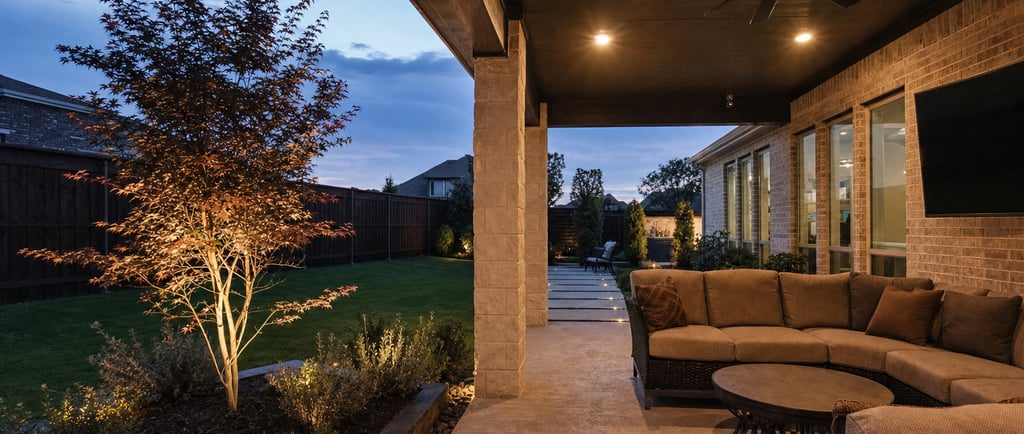
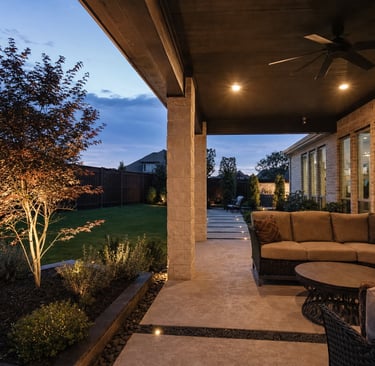
Outdoor lighting ideas for patios and walkways should do three jobs at once: help people move safely after dark, make the outdoor space feel inviting, and highlight the best parts of the yard without blasting light into everyone's eyes. For most homes, the best plan combines low-glare path lights, step lights where elevation changes, soft patio perimeter lighting, and a few accent lights for trees, stonework, or architectural details.
A good lighting layout is not about installing as many fixtures as possible. It is about placing the right light in the spots where people actually walk, sit, cook, carry drinks, unlock gates, and step down from one surface to another.
Start with how the space is used at night
Before choosing fixtures, walk the patio and walkway after sunset and notice where the dark spots become inconvenient. The most important zones are usually:
The route from the driveway or back door to the patio
Steps, grade changes, and uneven edges
Grill stations and outdoor kitchen areas
Seating and dining areas
Pool gates, side gates, and trash-can paths
Corners where landscape beds meet hardscape
For North Texas homes, this planning step matters because outdoor spaces often work hard in the evening. Summer afternoons can be brutal, so patios get used later in the day when glare, shadows, and bugs all become part of the decision.
Use path lights to guide, not decorate every foot
Path lights work best when they create a gentle rhythm along a walkway. Staggering fixtures from one side to the other usually looks more natural than placing them directly across from each other. On a straight walkway, that keeps the path from looking like an airport runway. On a curved walkway, it helps the eye follow the shape of the path.
For a front walk or backyard path, warm LED fixtures with shielded tops are usually a better choice than bright exposed bulbs. The goal is to see the walking surface, not the light source.
Good path-light locations include:
Outside curves where people naturally need guidance
Near steps or surface transitions
Beside planting beds where fixtures can blend into the landscape
Along the approach to a patio, pergola, gate, or outdoor kitchen
Avoid placing path lights where mower wheels, edging equipment, pets, or kids are likely to knock them loose. That one detail saves a lot of nuisance maintenance.
Add step lights anywhere a foot can miss the edge
If a patio drops down to a walkway, pool deck, or lower seating area, step lighting should be treated as practical safety lighting first. A beautiful patio still feels unfinished if guests have to use a phone flashlight to find the edge.
Step lights can be recessed into risers, mounted low on nearby walls, or placed as compact fixtures beside the transition. The best choice depends on the material. Stone, brick, concrete, wood, and metal each require a different mounting approach.
For new patios, steps, retaining walls, and seat walls, it is much easier to plan lighting before the hardscape is finished. Retrofitting can still be done, but wire routing, drilling, and fixture placement become more limited.
Layer patio lighting instead of relying on one bright fixture
One overhead floodlight can technically illuminate a patio, but it usually makes the space feel harsh. Layered lighting feels better and performs better.
A practical patio lighting mix might include:
Low perimeter lights around the patio edge
Downlights from a pergola or covered structure
Sconce-style lighting near doors or outdoor kitchens
Soft uplighting on nearby trees or columns
Task lighting around a grill or prep counter
The tradeoff is control. More lighting zones give the homeowner more flexibility, but they also require better planning. A dining area may need soft light, a grill needs clearer task lighting, and a walkway needs low, steady visibility. Putting everything on one switch can make the whole system less useful.
Choose warm light for patios and walkways
Warm white light usually fits outdoor living spaces better than cool white light. It feels calmer, works well with stone and brick, and is less jarring from inside the house. Bright blue-white lighting can make a backyard feel commercial, especially around patios and seating areas.
Fixture brightness should be modest. A walkway does not need to look like a parking lot. In many yards, lower-output fixtures placed thoughtfully outperform high-output fixtures placed carelessly.
Use accent lighting sparingly
Accent lighting should call attention to the best permanent features in the yard. That might be a live oak, a stone seat wall, a masonry column, a water feature, or a textured privacy wall. One or two well-placed accent lights can make a patio feel custom after dark.
Too many accent lights create visual clutter. If every shrub, wall, and corner is highlighted, nothing feels special. Legendary Outdoor Solutions usually looks for the features that already anchor the outdoor space, then uses lighting to support those focal points.
Low-voltage, solar, or line-voltage: what fits best?
For most patio and walkway projects, low-voltage LED lighting is the strongest everyday option. It is efficient, flexible, and well-suited for path lights, step lights, accent lights, and patio perimeter lighting.
Solar lights can work for very simple paths where performance is not critical. They are inexpensive and easy to place, but they depend on sun exposure and battery condition. In shaded side yards, covered patio areas, or stretches with heavy tree cover, solar fixtures often become inconsistent.
Line-voltage lighting has its place for certain wall-mounted fixtures, structures, or high-output needs, but it requires more electrical care and may involve licensed electrical work. If a lighting plan needs new outlets, hardwired fixtures, transformer locations, or controls tied into the home, it should be planned carefully instead of improvised after the patio is finished.
What drives the cost the most
Outdoor lighting cost depends less on one fixture and more on the whole system. The biggest drivers are:
Number and quality of fixtures
Transformer size and location
Wire length and routing difficulty
Existing patio, walkway, wall, or landscape conditions
Controls, timers, smart features, or multiple zones
Whether trenching, drilling, or hardscape modification is needed
A simple walkway-lighting upgrade is very different from a full patio, pathway, outdoor kitchen, and accent-lighting plan. Homeowners can control cost by deciding which areas need functional lighting now and which features can be added later.
North Texas planning details homeowners should not ignore
Forney, Terrell, and nearby North Texas yards bring a few practical considerations. Clay soil movement can affect posts, stakes, conduit routes, and hardscape edges over time. Heavy rain can expose shallow wire runs or leave fixtures sitting in soggy beds if drainage was not considered. Summer heat can also punish cheap plastics, weak finishes, and low-grade connectors.
Good lighting is not just a pretty night photo. It should be planned around drainage, mowing patterns, irrigation heads, soil movement, and future landscape growth. A fixture that looks perfect on installation day can become buried by plants or knocked sideways by maintenance if the layout is too tight.
A simple lighting plan that works for many homes
A balanced patio-and-walkway layout often looks like this:
Path lights staggered along the main walkway
Step lights at every elevation change
Softer patio-edge lighting around seating areas
Task lighting near the grill or outdoor kitchen
One or two accent lights on a tree, wall, or masonry feature
Timer or smart control so the system works without daily adjustment
That approach keeps the design practical. The walkway is safer, the patio feels usable, and the yard gains depth without becoming overlit.
Maintenance is part of the design
Outdoor lighting needs occasional attention. Fixtures may need adjustment after soil movement, mulch work, plant growth, or mowing. Lenses can collect dust, hard-water spots, pollen, and spider webs. Connections should stay protected from moisture, especially in beds that hold water after storms.
Choosing durable fixtures and planning serviceable wire routes makes maintenance easier. The cheapest fixture is rarely the cheapest system if it has to be replaced early or constantly straightened.
The best outdoor lighting feels intentional
The strongest patio and walkway lighting plans do not call attention to themselves. They make the space easier to use, safer to walk through, and better looking after sunset. If the lighting helps people move naturally from the house to the patio, see the steps, enjoy the seating area, and notice the best landscape features, it is doing its job.
Legendary Outdoor Solutions can help plan patio and walkway lighting as part of a larger outdoor living design, hardscape upgrade, or backyard improvement project. The best time to think through lighting is before the patio, walkway, seat wall, pergola, or outdoor kitchen is built, but a smart retrofit can still make a major difference.
(214) - 557 - 7809
© 2025. All rights reserved.
Call or Text
Inquire
Office Hours
Monday - Friday 8am-6pm
Saturday 8am-12pm
Transforming your backyard into a stunning oasis. We specialize in custom builds, including patios, pergolas, shops, and pools. As a turnkey solution, we manage every aspect of your project—from initial planning and permit pulling to the completed end product.
With years of experience, we pride ourselves on professionalism and reliability, delivering top-quality grading, excavating, and concrete work—done right the first time.
Your satisfaction is our priority! Get a Free Estimate today to start creating your perfect outdoor space!
Legendary Outdoor Solutions: